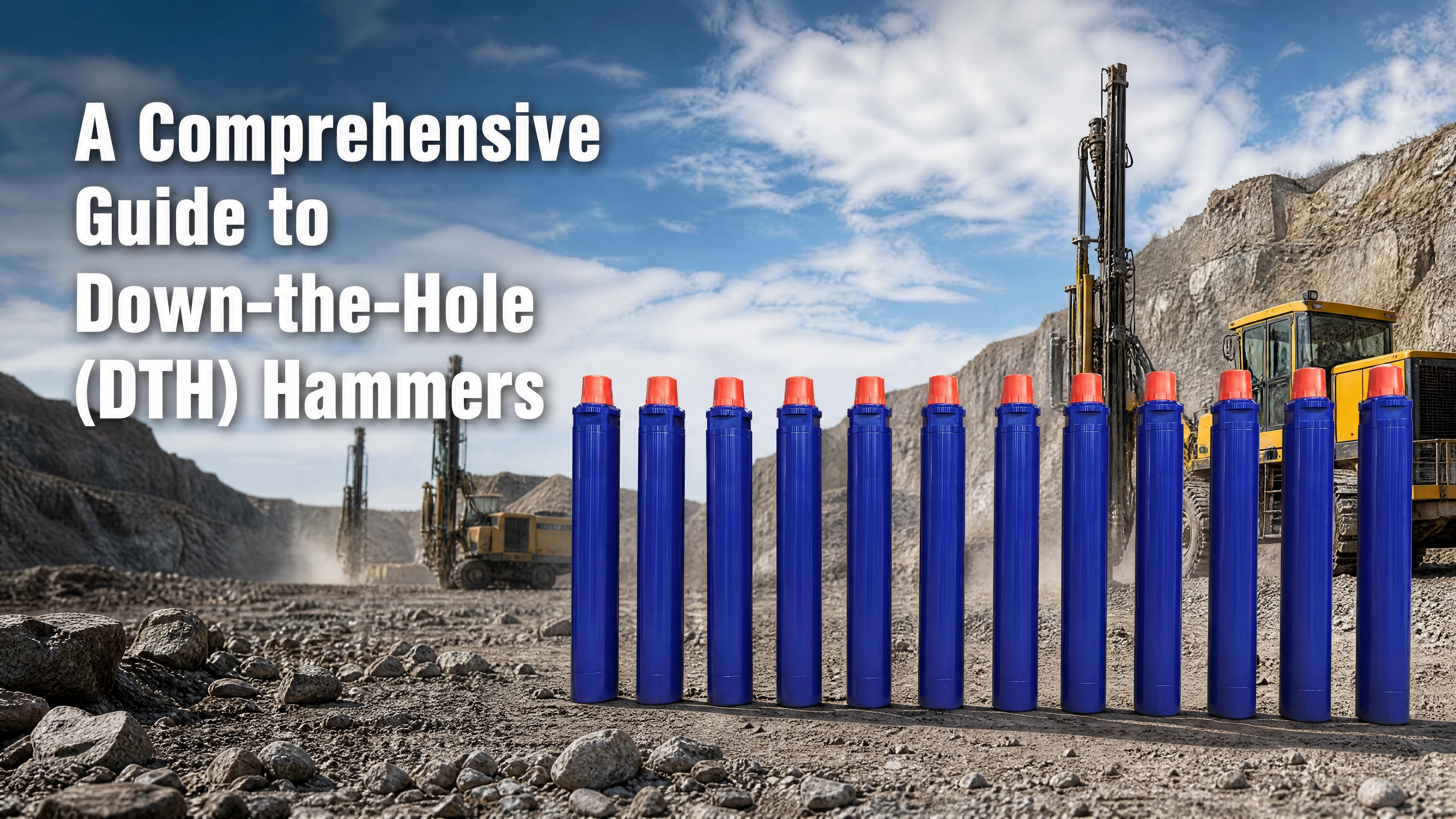
 Understanding the DTH Hammer: Structure, Principles, and Key Parameters
— A technical guide from a specialized DTH hammer manufacturing plant
In the field of hard-rock drilling, the Down-The-Hole (DTH) hammer is undoubtedly one of the most essential tools. Whether for mining, water well drilling, or infrastructure piling projects, the DTH hammer’s efficient rock-breaking capability is indispensable. However, for many first-time users, questions often arise: What is the internal structure of a DTH hammer? How does it work? What key parameters should be considered? Drawing on our factory's years of manufacturing experience, this article provides a comprehensive breakdown of the technical essentials of DTH hammers.
I. What is a DTH Hammer?
The DTH hammer is a pneumatic impact drilling tool. Mounted at the leading end of the drill string, it travels down the borehole to the bottom. It utilizes high-pressure compressed air to drive an internal piston in a high-speed reciprocating motion, striking the drill bit to shatter the rock. The defining characteristic of the DTH hammer is that impact energy is applied directly at the bottom of the hole; this minimizes energy loss and maximizes drilling efficiency, making it particularly suitable for medium-hard to extremely hard rock formations.
DTH hammers are a core product on our factory's production lines. Our high-air-pressure DTH hammers have been exported to numerous countries and regions, finding wide application in various hard-rock drilling projects.
II. Core Structure of the DTH Hammer
A DTH hammer consists of multiple precision components, each directly influencing the unit's overall performance and service life. Below, we introduce the main components and their functions:
The top sub is located at the very top of the DTH hammer and connects to the drill string; it houses the check valve internally. Manufactured from high-strength alloy steel, the top sub features precision-machined threads to ensure a secure and reliable connection to the drill string.
The check valve is a one-way valve designed to allow compressed air to enter the DTH hammer while automatically closing when the air supply stops, thereby preventing rock cuttings, water, and sediment from backflowing into the hammer. The sealing performance of the check valve directly impacts the reliability and service life of the DTH hammer.
The air distributor (also known as the valve seat) is the core component controlling the flow of compressed air. It dictates the timing and rhythm of the piston's impact and return strokes. The mating clearance for the air distribution seat is typically controlled between 0.05 and 0.10 mm; the surface undergoes carburizing and quenching, achieving a hardness exceeding HRC55.
The inner cylinder serves as the precision chamber where the piston reciprocates. Its bore is honed to a high surface finish with precise tolerances, ensuring smooth piston movement and preventing air leakage.
The piston is the heart of the DTH (Down-The-Hole) hammer. It reciprocates at high speed within the chamber formed by the outer and inner cylinders, striking the drill bit shank to transmit impact energy. Typically made from high-quality alloy structural steel, the piston undergoes carburizing, quenching, and cryogenic treatment; this results in a surface hardness of HRC58–62 while maintaining core toughness to prevent breakage.
The outer cylinder acts as the housing for the entire DTH hammer, protecting internal components while withstanding axial thrust and rotational torque during drilling. Generally made from high-strength alloy steel (such as 42CrMo) and subjected to overall quenching and tempering, the cylinder features a precision-machined bore that ensures excellent concentricity and wear resistance.
The bit retaining sleeve (or bit retainer) secures the drill bit, preventing it from detaching from the front of the hammer while allowing for a degree of axial float to ensure effective energy transfer.
The drill bit is the terminal component that makes direct contact with the rock. Its face is embedded with cemented carbide buttons that crush the rock under the piston's repeated impacts. Designs regarding the bit face shape, button profile, and flushing grooves vary according to the specific rock formation.
At our factory, every DTH hammer component undergoes over a dozen inspection steps from raw material intake to final product shipment. We recognize that only when every part meets design specifications can the complete DTH hammer operate reliably under extreme working conditions.
III. Working Principle of the DTH Hammer
The operation of a DTH hammer can be broken down into four continuous steps: air intake, impact stroke, return stroke, and cuttings discharge. These steps repeat in a cycle, creating a high-speed impact process. Step 1: Air Intake and Non-Return
High-pressure compressed air enters the top sub of the DTH (Down-The-Hole) hammer through the drill string, pushes open the check valve, and enters the sealed chamber formed by the air distributor, cylinder, and piston. The check valve ensures unidirectional airflow. If the air compressor stops supplying air, the check valve closes immediately to prevent rock cuttings and mud at the bottom of the hole from being sucked back into the hammer.
Step 2: Impact Stroke
Compressed air passes through the air distributor into the rear chamber above the piston. As pressure rises, the piston is accelerated downward. It strikes the shank of the drill bit at the front of the hammer at extremely high speed, generating a powerful impact. This force is transmitted through the bit to the rock, causing it to crack and shatter. At the end of the impact stroke, the piston opens specific exhaust ports, preparing for the return stroke.
Step 3: Return Stroke
After the piston strikes the bit, the air distributor automatically switches the airflow direction. Compressed air enters the front chamber below the piston, pushing it back to its original position. As the piston moves upward, exhaust air from the rear chamber is vented through the air distributor and the central hole of the drill bit. Once the piston returns to its starting position, the air distributor switches the airflow direction again to begin the next impact stroke.
A standard DTH hammer typically operates at an impact frequency of 800 to 2,000 blows per minute. This means the piston completes a full reciprocating cycle between ten and thirty times per second.
Step 4: Cuttings Removal (Flushing)
During each impact and return cycle, exhaust air is expelled at high velocity through the flushing holes located in the center of the drill bit. This airflow blows the shattered rock cuttings away from the bottom of the hole and carries them to the surface through the annular space between the drill string and the borehole wall. Efficient cuttings removal is a major advantage of DTH hammers over other drilling methods; it ensures the bit is always in contact with fresh rock, preventing the re-crushing of existing debris.
IV. Differences Between Valved and Valveless DTH Hammers
DTH hammers are classified into two types—valved and valveless—based on their air distribution mechanism. Valved DTH (Down-The-Hole) hammers utilize a separate air distribution valve to control airflow direction. These hammers feature a shorter piston and deliver higher energy per blow, making them suitable for drilling in extremely hard rock. The advantages of the valved design include high impact force and reliability, while the disadvantage is a higher number of components.
Valveless DTH hammers do not have a separate air distribution valve; instead, they rely on the piston's own position to control air circuit switching. These hammers have fewer parts, a higher impact frequency, and offer outstanding drilling efficiency in medium-hard rock formations. The advantages of the valveless design are its compact structure and ease of maintenance.
Our factory manufactures both valved and valveless DTH hammer series, allowing customers to make flexible choices based on actual rock conditions and drilling requirements. We recommend valved DTH hammers for extremely hard rock, whereas valveless DTH hammers offer greater efficiency advantages for medium-hard rock and high-volume drilling operations.
V. Key Parameters of DTH Hammers
When selecting and using DTH hammers, the following key parameters require particular attention:
Impact energy refers to the energy generated by a single piston strike, measured in Joules. Higher impact energy enhances the hammer's ability to break hard rock. Impact energy depends on the piston's mass and impact velocity, typically ranging from 100 to 2,000 Joules.
Impact frequency is the number of times the piston strikes the drill bit per minute (blows per minute). A higher impact frequency results in more rock-breaking strikes per unit of time, leading to faster drilling speeds. Depending on the type and specification, impact frequencies typically range from 800 to 2,000 blows per minute.
Operating air pressure is the pressure of the compressed air required to drive the DTH hammer, measured in Megapascals (MPa). Low-pressure DTH hammers operate at 0.5 to 1.0 MPa, while high-pressure models operate at 1.5 to 3.0 MPa. High-pressure DTH hammers are currently the market standard due to their superior drilling efficiency.
Air consumption refers to the volume of compressed air consumed by the DTH hammer during operation, measured in cubic meters per minute. Air consumption varies significantly across different models of DTH (Down-The-Hole) hammers; small-diameter hammers typically consume 5 to 10 cubic meters of air per minute, while large-diameter hammers can consume 20 to 30 cubic meters per minute. When selecting an air compressor, it is essential to ensure its air supply capacity exceeds the hammer's air consumption rate.
The drilling diameter range refers to the size of the hole produced by the drill bit used with the DTH hammer. Different hammer specifications correspond to different drilling diameters. For instance, 3-inch class hammers typically drill holes ranging from 80 to 110 mm; 4-inch class hammers drill 105 to 135 mm holes; 6-inch class hammers drill 152 to 203 mm holes; and 8-inch class hammers drill 203 to 254 mm holes.
Drill pipe compatibility refers to the match between the hammer's top sub thread and the drill pipe model. Common drill pipe thread specifications include API 2-3/8 inch, API 3-1/2 inch, and API 4-1/2 inch. When purchasing a DTH hammer, ensure the thread specification matches the drill pipes used on-site.
At our factory, every DTH hammer undergoes impact performance and air consumption testing on a test bench before shipment to ensure all parameters meet design standards. We also provide professional model selection advice based on the customer's specific drill rig configuration and rock formation conditions.
VI. Proper Use and Maintenance of DTH Hammers
To maintain the DTH hammer in good condition and extend its service life, the following points are crucial:
Ensure adequate lubrication. During operation, specialized pneumatic lubricating oil must be mixed into the compressed air supply, with a consumption rate of approximately 0.5 to 2 milliliters per minute. Operating without oil causes dry friction between the piston and the cylinder, which can quickly lead to cylinder scoring, seizing, or even piston fracture.
Avoid dry firing (impact without load). The drill bit must be pressed firmly against the rock before activating the hammer's impact function. Continuous dry firing in mid-air causes the piston to strike the end cap and chuck directly, resulting in severe damage. This is the most common cause of DTH hammer failure.
Maintain stable air pressure. Maintain a continuous air supply during drilling; when stopping, cease the percussive action before retracting the drill bit to prevent rock cuttings from backflowing into the DTH (Down-The-Hole) hammer.
Inspect the drill bit regularly. Sharpen or replace the bit promptly when worn. A dull bit not only reduces drilling speed but also increases the load on the DTH hammer, accelerating the wear of internal components.
Perform periodic inspections. Dismantle and inspect the DTH hammer every 100 to 200 operating hours to clean out accumulated dust and check for wear on critical parts—such as the piston, cylinder, and air distributor—replacing worn components as necessary.
Our after-sales team provides detailed operation and maintenance manuals to every customer and can arrange for technical personnel to provide on-site training and guidance.
VII. Advantages of Choosing a Factory-Direct Supplier
In the DTH hammer industry, choosing a genuine manufacturing factory rather than a trading company offers the following benefits:
Greater price transparency. Factory-direct supply eliminates intermediary markups, allowing customers to benefit from ex-factory pricing.
Superior quality reliability. The factory oversees every stage of production, maintaining full control from raw materials to the finished product, thereby ensuring no refurbished or second-hand parts are used.
Greater technical expertise. Factory technicians are intimately familiar with the design details and manufacturing specifications of every component, enabling rapid response to troubleshooting and repair needs.
Greater customization flexibility. The factory can adjust connection thread specifications, surface treatments, material grades, and more to meet specific operational requirements.
Our factory specializes in the production of high, medium, and low air-pressure DTH hammers and matching drill bits. With over a decade of manufacturing experience, our products are ISO9001 certified. We support OEM and ODM customization and welcome domestic and international customers to visit our facility for consultations.
VIII. Summary
The DTH hammer utilizes compressed air to drive a piston in high-speed reciprocating motion within the cylinder, intermittently striking the drill bit and converting the air's pressure energy into the mechanical impact energy required to break rock. Its core structure comprises components such as the top sub, check valve, air distributor, inner cylinder, piston, outer cylinder, chuck, and drill bit. Key parameters include impact energy, impact frequency, operating air pressure, air consumption, drilling diameter range, and compatible drill pipe specifications. Understanding the structure, operating principles, and specifications of DTH (Down-The-Hole) hammers is essential for proper selection, operation, and maintenance.
Whether you are using standard DTH hammers such as the DHD, QL, or Mission series, they all rely on the same proven operational mechanics and design standards. If you are looking for a reliable DTH hammer supplier, please contact our factory. We offer comprehensive services, including sample testing, technical selection assistance, and after-sales training.
About Us: Our factory specializes in the production of high, medium, and low air-pressure DTH hammers and matching drill bits. With over a decade of manufacturing experience, our products are ISO9001 certified. Our core product range includes DTH hammers and drill bits in various specifications, such as the DHD, QL, and Mission series. We support OEM/ODM customization and welcome domestic and international clients to visit our facility for business discussions.
https://wa.me/8619173337543




 Inquiry
 Download
 Technical Support
 PRODUCT
 Events