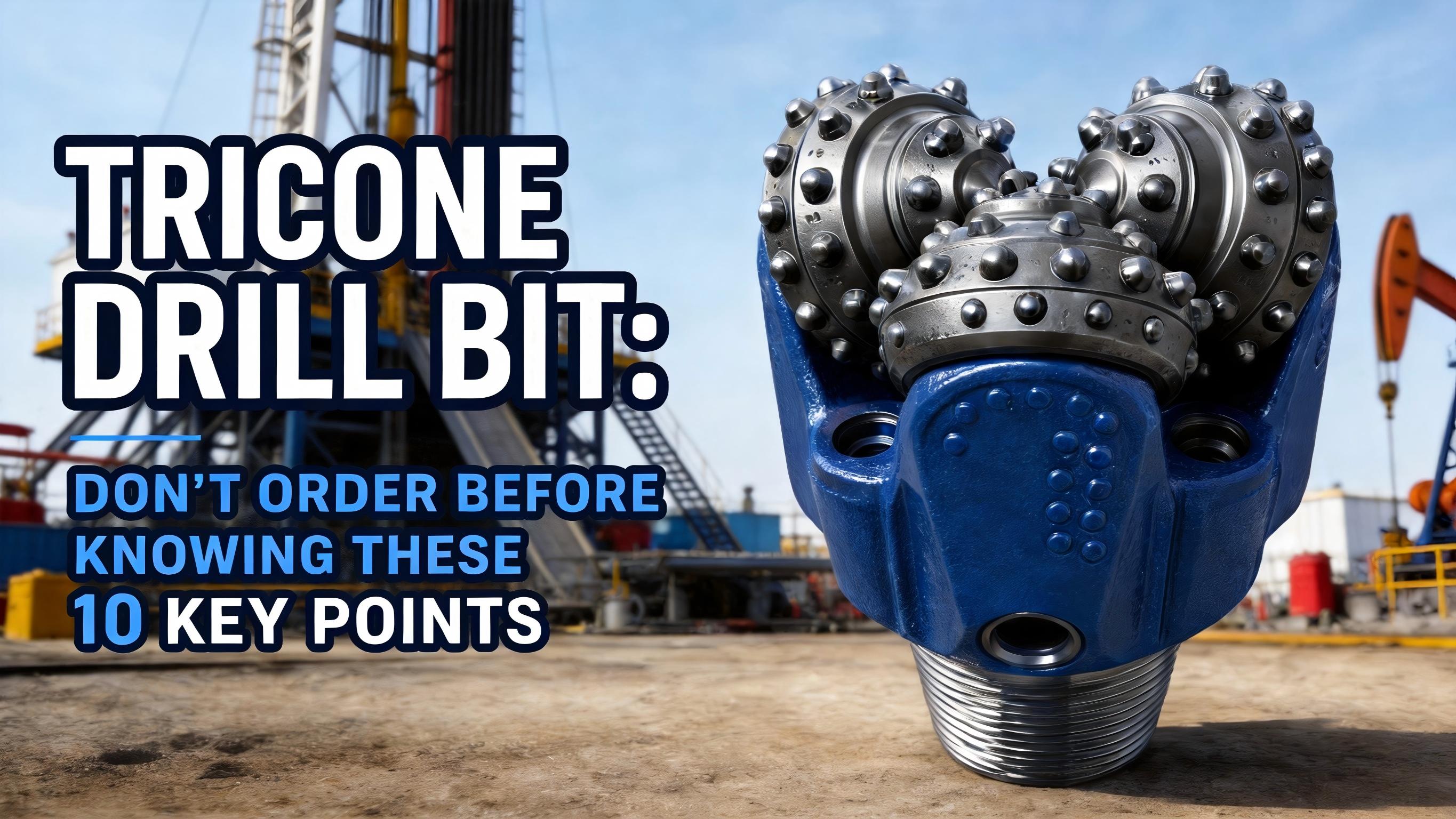
 Tricone Drill Bit: Don't Order Before Knowing These 10 Key Points
1. How does a tricone drill bit work?
A tricone drill bit works by having three conical cones roll on the bottom of the wellbore. The teeth on the cones impact, crush, and scrape the rock, thus breaking it. Each cone can rotate on its own axis while also revolving with the bit, achieving continuous rock fragmentation. This unique action makes the tricone drill bit highly effective in many drilling environments.
2. What formations is a tricone drill bit suitable for?
The tricone drill bit has very wide applicability.
For soft formations such as mudstone and shale, a steel-tooth tricone drill bit is preferred. The teeth are tall and sharp, offering high cutting efficiency.
For medium-hard formations like limestone and sandstone, a tungsten carbide insert (TCI) tricone drill bit works best.
For hard formations such as granite and basalt, a high-impact-resistant TCI tricone drill bit with blunt, wear-resistant teeth is required.
Selecting the right tricone drill bit for the specific formation is crucial.
3. How to choose between a tricone drill bit and a PDC bit?
A tricone drill bit breaks rock by impact and crushing. It is suitable for formations ranging from soft to extremely hard, especially brittle and heterogeneous strata. Its rotational speed is relatively low, generally 60–120 rpm, with moderate single-use cost and it can be refurbished.
A PDC bit shears rock and is suitable for soft to medium-hard formations. However, when encountering gravel or alternating soft/hard layers, PDC bits are prone to chipping. PDC bits can run at higher speeds but are single-use and have a higher unit price.
Simple conclusion: When drilling hard formations, interbedded layers, or gravel-containing strata, give priority to a tricone drill bit. For homogeneous soft to medium-hard formations, PDC bits are more efficient.
4. What are the key factors affecting the life of a tricone drill bit?
There are four main factors affecting tricone drill bit life:
Bearing type: Sealed bearings last much longer than open bearings and can handle higher rotary speeds.
Tooth design and material: Tungsten carbide insert teeth are more wear-resistant than steel teeth, but cost more.
Drilling parameters: Mismatched weight-on-bit (WOB) and rotational speed accelerate cone eccentric wear or tooth breakage.
Bottom hole cleaning: Inadequate removal of cuttings leads to regrinding, which accelerates tooth and bearing wear.
Properly managing these factors can significantly extend the life of any tricone drill bit.
5. Why do teeth fall off my tricone drill bit easily?
Common causes include:
Excessive WOB or impact load, creating micro-cracks around the tooth hole.
Formation hardness beyond the design range of the tricone drill bit, making the tooth insufficiently tough.
Bearing failure first causes the cone to lock, then teeth see abnormal stress.
Poor welding or tooth insertion quality, common in low-quality products.
Solution: Choose a tricone drill bit from a reputable manufacturer, strictly match the bit to the formation, and avoid excessively aggressive drilling parameters for long periods.
6. How to tell if the bearing of a tricone drill bit has failed?
Field experience tells us:
Sudden significant increase in drilling time (slower rate of penetration).
Irregular fluctuations in pump pressure, possibly due to a locked or loose cone.
Metal fragments or bearing balls in the returned cuttings.
After pulling out of hole, rotate each cone by hand.
A properly functioning tricone drill bit will have cones that turn smoothly without sticking or excessive play. If a cone is loose or stuck, the bearing has failed.
7. Can a worn tricone drill bit be repaired and reused?
Yes. Steel-tooth tricone drill bits can have their teeth rebuilt by hardfacing. For insert bits, damaged teeth can be replaced, and the bearing/seal system can be refurbished. However, refurbished tricone drill bits typically perform 10–20% below new ones, suitable for secondary sections or cost-sensitive projects. Many manufacturers offer trade in services, which are more economical than repairing yourself.
8. How to match rotation speed and weight-on-bit for a tricone drill bit?
There is no absolute formula, but for a common 215.9 mm (8½″) tricone drill bit, the following ranges are a good starting point:
Soft formations: WOB 30–60 kN, speed 100–150 rpm.
Medium-hard formations: WOB 60–100 kN, speed 80–120 rpm.
Hard formations: WOB 100–160 kN, speed 60–90 rpm.
Rule of thumb: For hard formations, use lower speed with higher WOB; for soft formations, use higher speed with lower WOB. Always refer to the manufacturer's recommended parameters for your specific tricone drill bit.
9. Besides price, what should you consider when buying a tricone drill bit?
Look at four key aspects:
Bearing type: Prioritize fully sealed rolling bearings – they give the longest life for your tricone drill bit.
Tooth profile design: Choose tooth shapes (wedge, conical, round-top, etc.) according to formation hardness.
Gauge protection: Good gauge design minimizes the risk of hole diameter reduction.
Manufacturer support: Technical assistance, failure analysis, trade in programs, etc.
These factors determine the true value of a tricone drill bit, not just the upfront price.
10. What are the most common mistakes new users make?
Here are the top five pitfalls to avoid when using a tricone drill bit:
Looking only at price, ignoring formation: Buying the wrong model leads to low footage and high cost per foot.
Randomly adjusting WOB and RPM: Assuming “faster is better” or “heavier is faster” destroys a tricone drill bit prematurely.
Ignoring bottom hole cleaning: Insufficient flow rate causes cuttings to be reground, wearing down teeth and bearings.
Not recording operating data: Failing to analyze wear patterns after each run means repeating the same mistakes.
Buying cheap no name bits: Poor sealing and heat treatment can cause cone loss or head breakage downhole – a costly fishing job.
Conclusion: The tricone drill bit may seem traditional, but when correctly selected, operated, and maintained, it delivers highly efficient and low cost drilling in hard and complex formations. We hope these 10 key points help you avoid costly mistakes. If you have any questions, please contact us for technical support.
https://wa.me/8619173337543




 Inquiry
 Download
 Technical Support
 PRODUCT
 Events